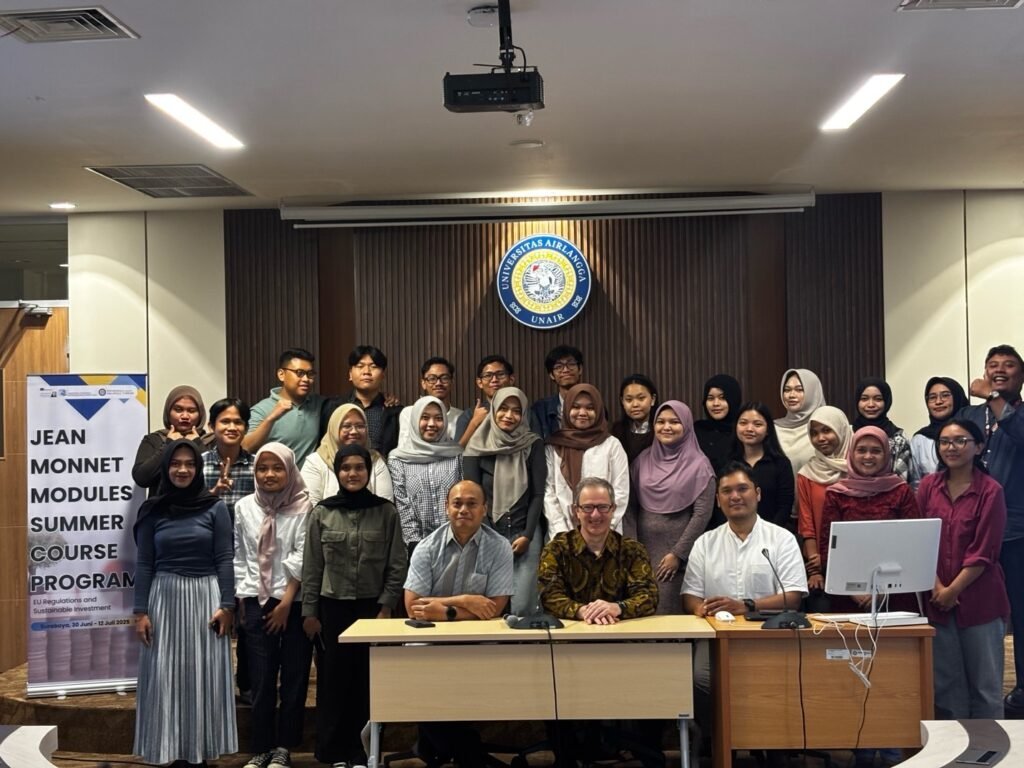
Surabaya, Indonesia — As businesses and economies become increasingly interconnected, sustainability is no longer a responsibility limited to individual companies or governments. From social enterprises addressing community needs to global Environmental, Social, and Governance (ESG) standards and regional economic cooperation, new approaches are emerging to balance economic growth with social and environmental priorities.
These issues became part of another series of academic discussions at the 2026 Jean Monnet Summer Course, hosted by Universitas Airlangga in collaboration with University Telematica Internazionale UniNettuno. The sessions explored the operational foundations of social enterprises, the implementation of global ESG standards, and the institutional framework of the European Union, while examining their relevance to the Southeast Asian context.
By placing European and ASEAN experiences alongside one another, the discussions encouraged participants to look beyond individual legal systems and consider how regional institutions can respond to shared challenges. The sessions ultimately highlighted a central question for modern regional cooperation: how can countries pursue collective economic progress while maintaining national sovereignty and responding to global sustainability demands?
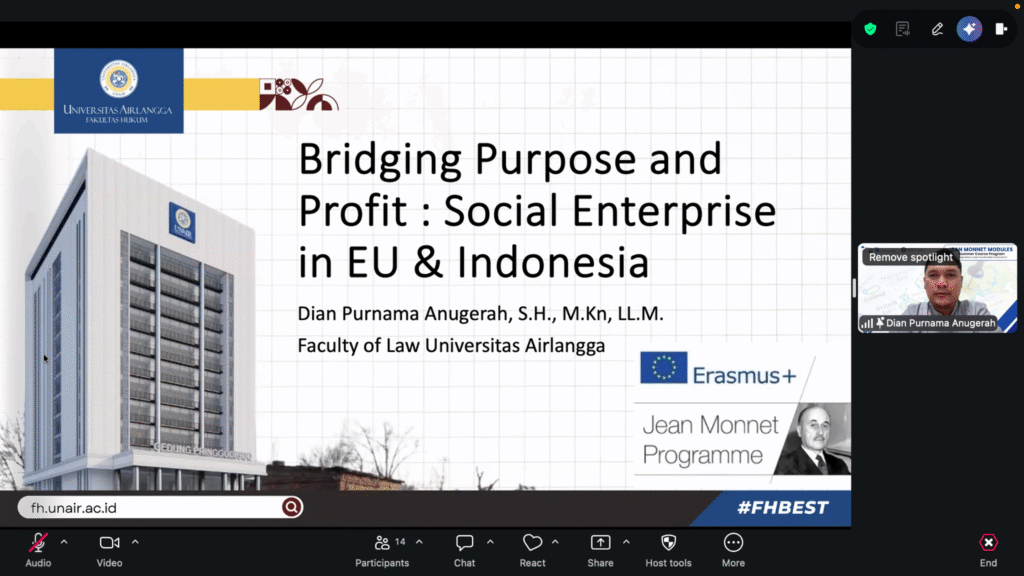
Turning Social Purpose into Sustainable Enterprise
The first discussion examined the foundations and operational mechanisms of social enterprises, organisations that combine entrepreneurial activities with broader social objectives. Unlike conventional businesses that primarily focus on financial returns, social enterprises seek to generate sustainable economic value while simultaneously addressing social or community needs.
The discussion highlighted the importance of developing appropriate institutional and legal frameworks to support these organisations. Social enterprises operate at the intersection of business and social policy, meaning their success depends not only on access to capital and markets but also on clear definitions, governance mechanisms, and accountability standards that ensure their social objectives remain central to their activities.
This model provides an alternative perspective on the relationship between business and social development. Rather than treating profitability and social impact as competing objectives, social enterprises demonstrate how entrepreneurial activity can be structured to create both economic and societal value. Their development therefore forms an increasingly relevant part of broader discussions on sustainable and inclusive economic growth
Making ESG Work Across Different Economies
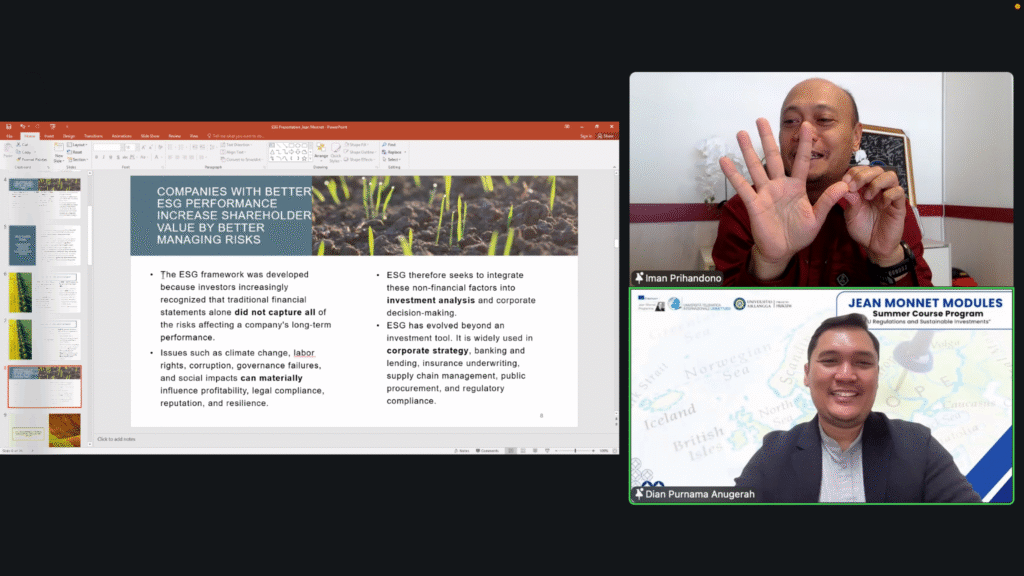
The second session focused on the implementation of Environmental, Social, and Governance (ESG) standards at the global level. As investors, regulators, consumers, and international markets increasingly demand greater corporate responsibility, ESG has become an important framework for assessing how businesses manage environmental impacts, social responsibilities, and governance practices.
However, implementing ESG standards consistently across different countries presents significant challenges. Countries differ in their levels of economic development, regulatory capacity, institutional structures, and social priorities. A framework that works effectively in one jurisdiction may therefore require adaptation before it can be applied meaningfully in another.
The discussion consequently emphasised that global ESG implementation requires more than simply adopting a common set of standards. Effective implementation depends on local regulatory capacity, institutional readiness, and meaningful stakeholder engagement. The challenge is to create sustainability standards that maintain global credibility while remaining sufficiently flexible to reflect different national and economic contexts.
Understanding the European Commission and the EU Model
The third discussion turned to the institutional structure of the European Union, with particular attention to the role and functions of the European Commission. As one of the EU’s central institutions, the Commission plays an important role in developing policies, proposing legislation, and supporting the implementation of common European objectives across member states.
The discussion also introduced participants to the distinctive nature of the EU’s supranational legal system. Unlike traditional international organisations, the EU has developed institutions and legal mechanisms that allow certain decisions and laws to operate beyond the purely national level. This structure enables member states to coordinate policies and pursue shared economic and political objectives through common institutions.
However, the European model cannot simply be transferred directly to ASEAN. The two regional organisations operate according to fundamentally different institutional principles: the EU has developed a supranational framework, while ASEAN remains primarily an intergovernmental organisation that places strong emphasis on national sovereignty and consensus. Differences in political systems, economic development, and institutional structures make direct replication unrealistic.
ASEAN, Digitisation, and the Green Transition
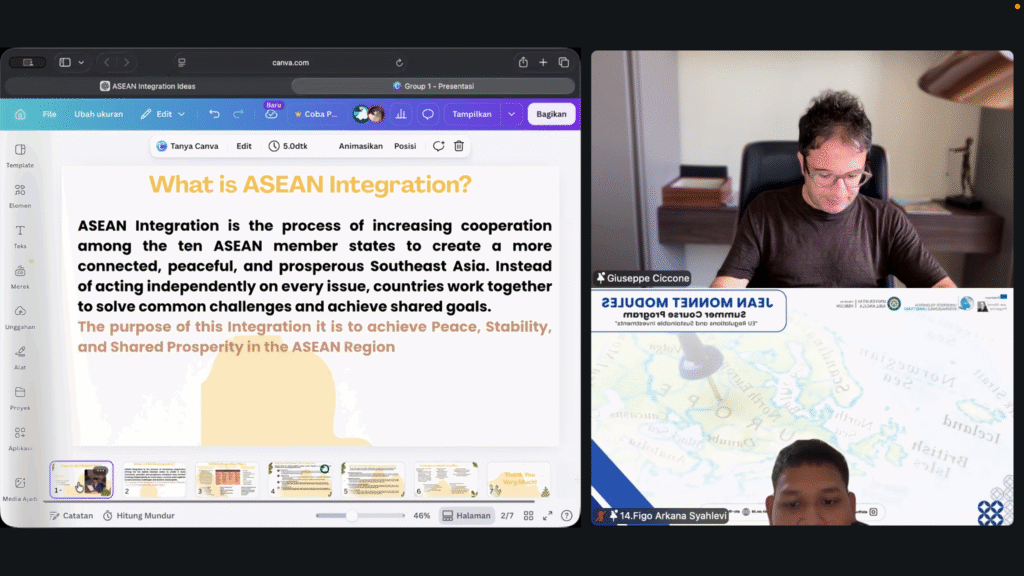
The comparison nevertheless provides valuable lessons for Southeast Asia. The discussion explored how digitisation and green energy could serve as practical drivers of deeper regional integration, even without replicating the European Union’s supranational model.
Digital technologies can strengthen cross-border connectivity, facilitate trade, improve access to information, and support cooperation among businesses and governments. At the same time, the development of renewable energy and interconnected green infrastructure could create new opportunities for countries across Southeast Asia to address shared environmental challenges while strengthening regional economic resilience.
These developments suggest that regional integration does not necessarily require identical political or legal structures. Instead, cooperation can develop through shared priorities and practical mechanisms that respect national differences. For ASEAN, the challenge is therefore to identify areas where collective action can generate greater benefits while preserving the principle of national sovereignty.
Learning from Different Paths to Integration
Taken together, the sessions demonstrate that there is no single model for achieving sustainable and inclusive economic development. Social enterprises illustrate how businesses can integrate social objectives into their operations, while ESG frameworks seek to strengthen corporate accountability across increasingly global markets. Meanwhile, the European Union provides an example of how countries can establish common institutions to pursue shared objectives, while ASEAN demonstrates a different model centred on intergovernmental cooperation.
The comparison between the EU and ASEAN also highlights the importance of understanding regional integration within its own political and economic context. European institutions cannot simply be replicated in Southeast Asia, but their experiences can provide valuable lessons on institutional coordination, regulatory cooperation, and the pursuit of common economic goals.
Through the Jean Monnet Summer Course 2026, participants were encouraged to critically examine how different regions navigate the balance between national sovereignty, economic integration, and sustainability. Ultimately, the discussions suggest that the future of regional cooperation may not depend on creating identical systems, but on finding innovative ways to connect economies, advance green development, and create shared progress while respecting the diversity of each region.