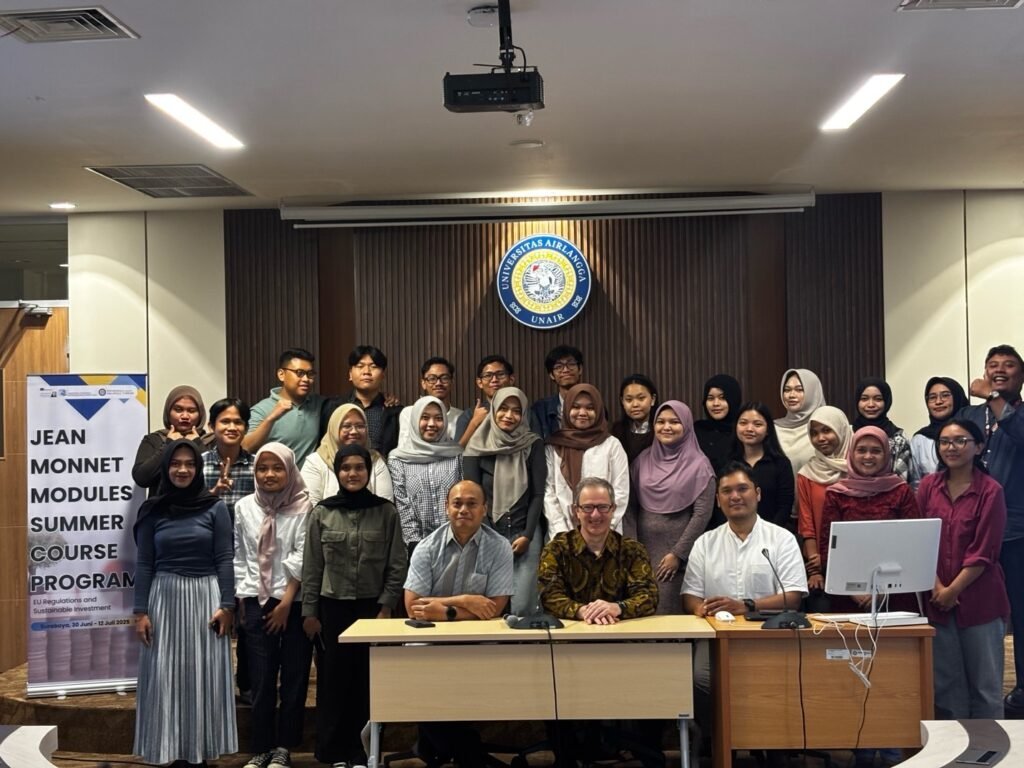
Surabaya, Indonesia — What makes a legal framework effective in responding to environmental challenges? And how can international cooperation help countries address issues that increasingly cross national borders?
These questions shaped another series of academic discussions at the 2026 Jean Monnet Summer Course, hosted by Universitas Airlangga in collaboration with University Telematica Internazionale UniNettuno. Bringing together perspectives on Indonesian environmental law and the historical development of the European Union (EU), the sessions invited participants to explore how legal systems evolve in response to complex environmental, economic, and political challenges.
The discussions moved from Indonesia’s constitutional commitment to environmental protection to the historical foundations of European integration, offering students a broader understanding of how law can become a tool for cooperation, sustainability, and long-term development.
Understanding Indonesia’s Environmental Legal Framework
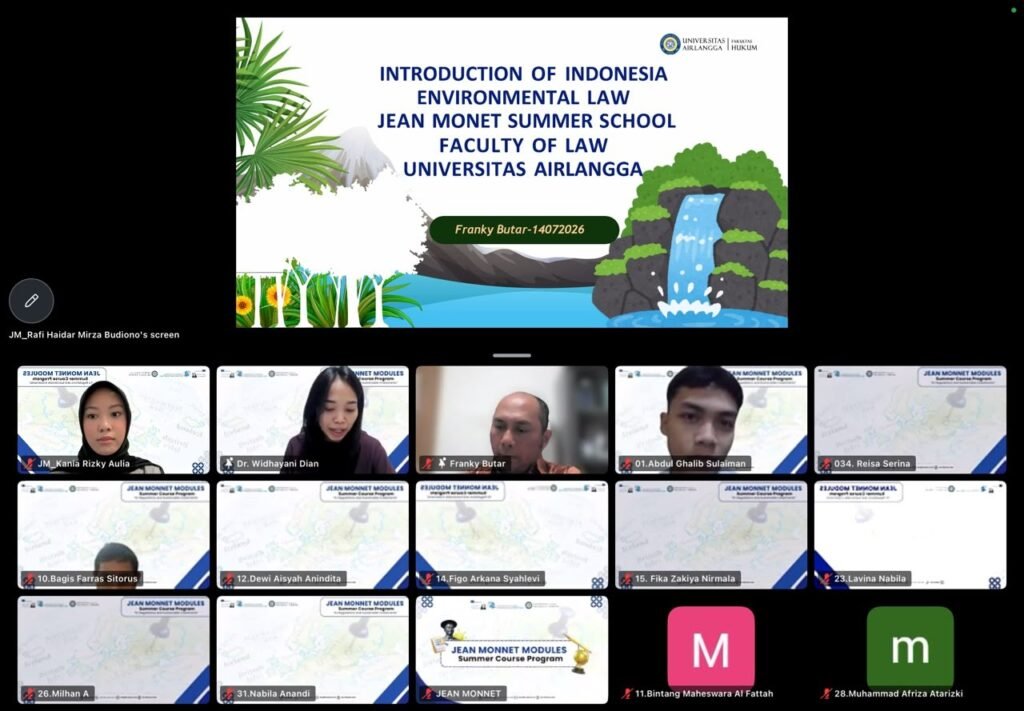
One of the sessions, led by Franky Butar-Butar, examined the development of environmental law in Indonesia and the international influences that have shaped the country’s regulatory framework.
The discussion highlighted the significance of international environmental milestones, particularly the Stockholm Declaration and the Rio Declaration, in influencing the development of environmental policies and legal principles in Indonesia. These international commitments contributed to a growing recognition that environmental protection is not merely a matter of policy, but an essential component of sustainable development.
At the national level, this principle is reinforced through the constitutional recognition of the right to a healthy environment. The legal framework provides various instruments through which environmental protection can be pursued, including mechanisms addressing pollution, environmental management, and the implementation of sustainable development principles.
The discussion therefore placed environmental law within a broader legal framework: one that seeks to balance economic activity and development with the responsibility to protect the environment and public welfare.
From Coal and Steel to a United Europe
While the Indonesian session focused on environmental governance, the following lectures shifted the discussion toward the history and development of the European Union.
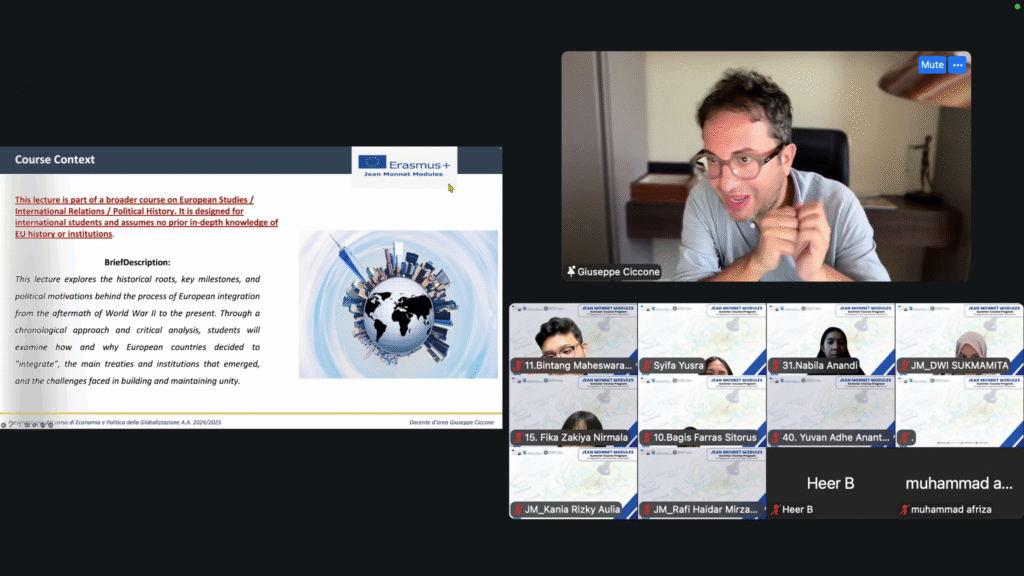
European academics traced the origins of European integration back to the establishment of the European Coal and Steel Community, an early initiative designed to promote cooperation and reduce the possibility of conflict among European states by placing key industries under a common framework.
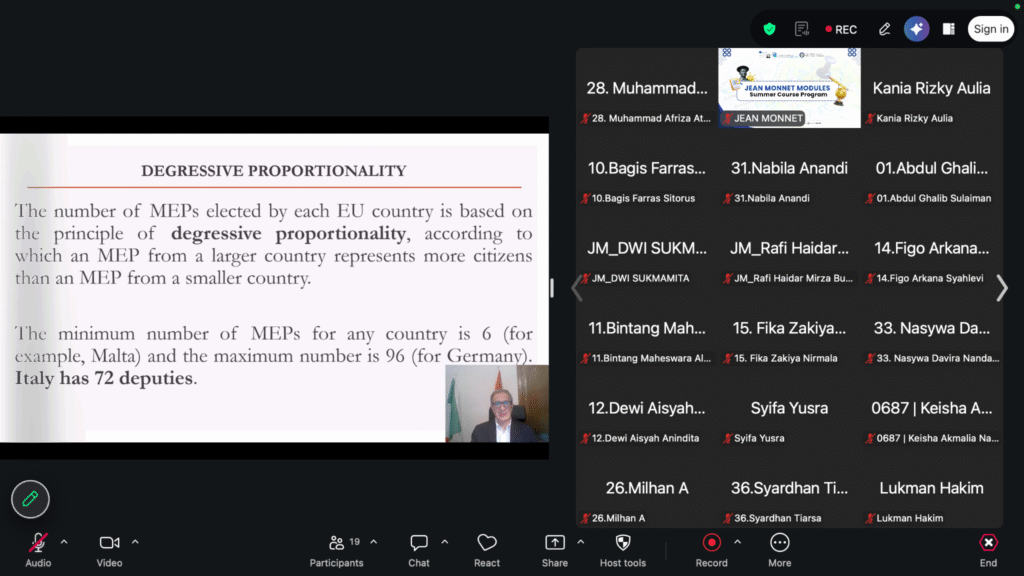
The process of integration continued to develop, eventually leading to the creation of the Common Market through the Treaty of Rome. At the heart of this framework were the EU’s foundational four freedoms: the free movement of goods, services, capital, and people.
These principles illustrate how legal integration can transform relationships between states. Rather than functioning solely as a collection of national legal systems, European integration created a shared legal and economic space in which cooperation could facilitate greater mobility, trade, and economic interaction.
Understanding the Institutions Behind Integration
The sessions also introduced participants to the institutional structure that supports European integration, including the role of the European Parliament.
Understanding these institutions is essential to appreciating how EU policies and regulations are developed, implemented, and coordinated across member states. The EU’s institutional framework demonstrates that regional integration requires more than political agreements, it also depends on legal mechanisms and institutions capable of translating shared objectives into practical policies.
For students of law, this provides an important comparative perspective on how different levels of governance can interact to address common challenges.
Connecting Environmental Governance and European Integration
Although Indonesian environmental law and European integration may initially appear to be separate topics, the sessions revealed an important connection: both demonstrate the power of law to facilitate cooperation in addressing challenges that extend beyond individual interests or national borders.
Environmental issues such as pollution and climate change increasingly require cooperation across jurisdictions, while economic integration demands common rules capable of coordinating relationships between states.
The comparison also highlights the importance of interdisciplinary legal thinking. Environmental protection intersects with economics, international relations, public policy, and human rights, while European integration combines legal, political, and economic dimensions within a shared regional framework.
Through these discussions, participants were encouraged to look beyond legal rules in isolation and examine how legal frameworks operate within broader social, economic, and international contexts.
Law as a Bridge for Global Challenges
The sessions ultimately reinforced a central message of the Jean Monnet Summer Course 2026: contemporary challenges require legal approaches that are both interdisciplinary and internationally connected.
Indonesia’s environmental framework demonstrates how international principles can influence domestic law and strengthen the protection of environmental rights. Meanwhile, the history of European integration illustrates how countries can develop shared legal frameworks to facilitate cooperation, economic interaction, and regional stability.
By bringing these perspectives together, the programme provides students with an opportunity to understand law not simply as a system of rules, but as a dynamic instrument for cooperation, sustainability, and social progress.
As environmental and economic challenges continue to transcend national boundaries, the ability to understand different legal systems and the connections between them—becomes increasingly important. The Jean Monnet Summer Course 2026 offers precisely this comparative space, encouraging a new generation of legal thinkers to explore how law can help build more cooperative, sustainable, and resilient societies.