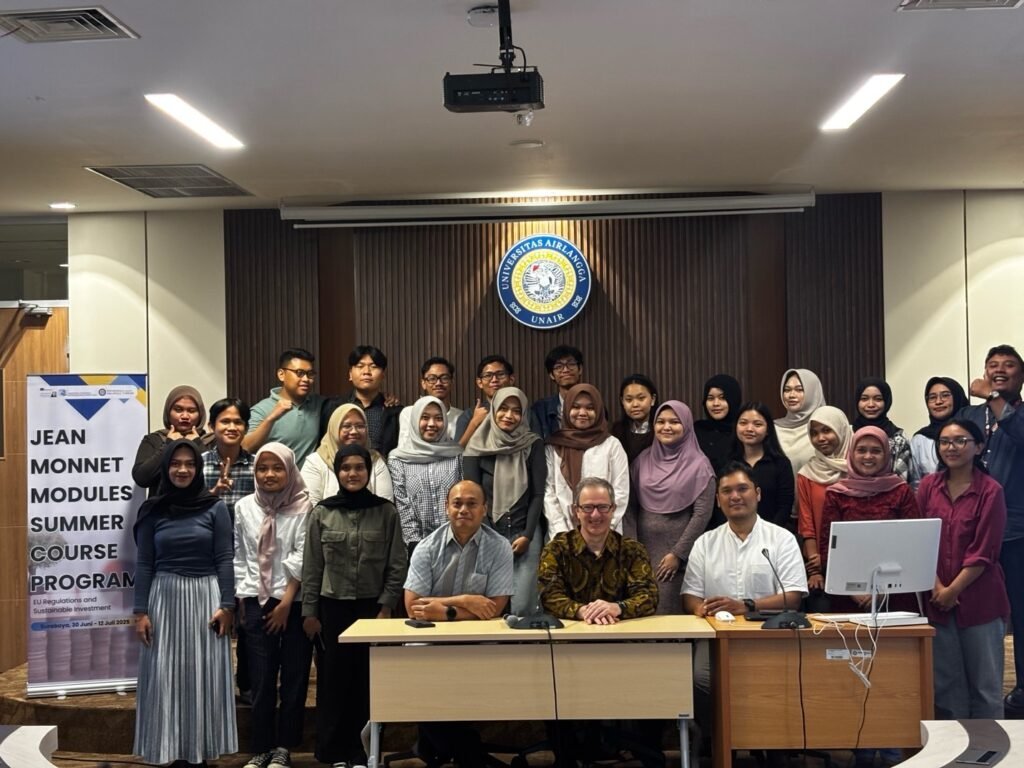
Surabaya, Indonesia — How can law keep pace with economic growth while protecting the environment and ensuring social inclusion? This question became one of the central themes at the 2026 Jean Monnet Summer Course, hosted by Universitas Airlangga in collaboration with University Telematica Internazionale UniNettuno.
Bringing together perspectives on European Union (EU) regulations, sustainable investment, international trade, and the green economy, the summer course opened an intensive academic discussion on how legal frameworks can respond to some of the world’s most pressing economic and environmental challenges.
Rather than treating regulation as a rigid set of rules, the programme encouraged participants to see law as a dynamic instrument—one that can influence investment decisions, shape economic development, and promote environmental and social responsibility.
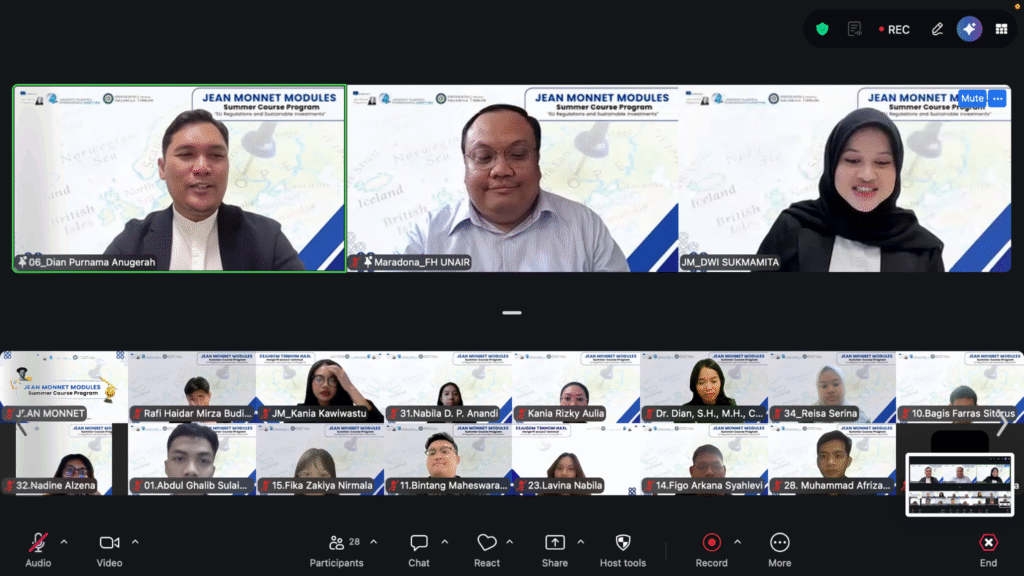
From International Trade to Sustainable Development
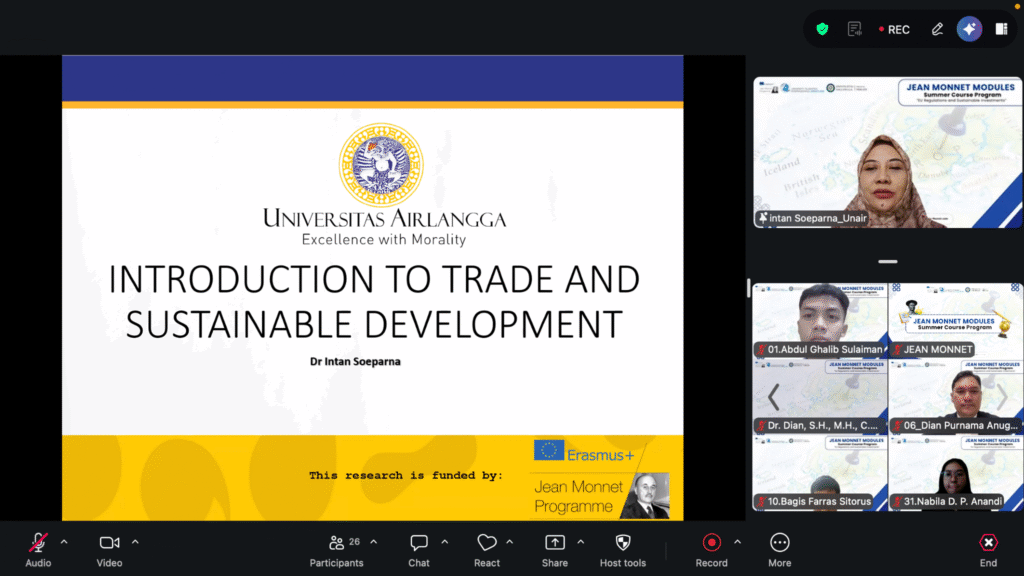
One of the key perspectives was presented by Mrs. Intan Soeparna, who explored the relationship between international trade and the United Nations Sustainable Development Goals (SDGs).
Her discussion highlighted that international trade cannot be viewed solely through the lens of economic growth. Trade policies are also closely connected to broader development challenges, including poverty reduction, food security, and gender equality.
This perspective invites participants to look beyond questions of efficiency and market expansion. The way international economic relations are regulated can determine who benefits from economic growth—and whether those benefits contribute to more inclusive and sustainable development.
By placing human development at the centre of the discussion, Soeparna’s lecture demonstrated how legal and economic policies can work together to address challenges that extend far beyond national borders.
Green Economy: Beyond the “Green” Label
The conversation then moved toward another increasingly important issue: the green economy.
Through his introductory material, Mr. Jacopo Cappuccio encouraged participants to approach green economy policies with a critical mindset. The transition toward a greener economy may create significant opportunities for sustainable investment, but it also brings complex legal, economic, and social questions.
Who bears the cost of the transition? How should green investments be regulated? How can environmental objectives be balanced with economic interests? And, perhaps most importantly, how can sustainability policies ensure that no groups are left behind?
These questions underline the importance of looking beyond the label of “green.” Effective environmental policies require not only ambitious goals, but also sound legal frameworks, realistic implementation strategies, and careful consideration of competing interests.
Cappuccio’s perspective therefore reinforced one of the course’s key messages: sustainable development requires critical thinking, not one-size-fits-all solutions.

European Standards Meet Indonesian Realities
At the heart of the Jean Monnet Summer Course 2026 is a comparative legal perspective that connects European Union standards with the Indonesian context.
By bringing European regulatory approaches into conversation with Indonesian realities, the programme provides participants with an opportunity to examine how legal instruments can support sustainable investment while addressing environmental and social concerns.
This comparative approach is particularly relevant as governments, businesses, and international institutions increasingly seek regulatory frameworks capable of balancing economic development with sustainability.
The course positions EU law not simply as a foreign legal system to be studied, but as a valuable reference point for understanding how regulation can respond to global challenges—and how such approaches might be interpreted, adapted, or critically evaluated within Indonesia.
Building a Critical Generation of Legal Thinkers
The opening programme ultimately established a strong foundation for the broader objectives of the Jean Monnet Summer Course 2026: to equip students with the knowledge and analytical skills to critically assess the relationship between law, economic development, and sustainability.
From international trade and the SDGs to green economy policies and sustainable investment, the discussions emphasized that today’s global challenges demand legal thinking that crosses borders and disciplines.
As European and Indonesian economies continue to navigate the transition toward more sustainable models of development, understanding the role of regulation becomes increasingly important.
Through its comparative and interdisciplinary approach, the Jean Monnet Summer Course 2026 offers more than an exploration of EU regulations. It creates a space for students to question, compare, and rethink how law can contribute to a greener, more inclusive, and more sustainable future.