Surabaya, Indonesia — Behind every mining operation lies a complex web of legal responsibilities. From determining who has the authority to issue mining permits to ensuring that environmental obligations are fulfilled, mining law sits at the intersection of economic development, natural resource governance, and environmental protection.
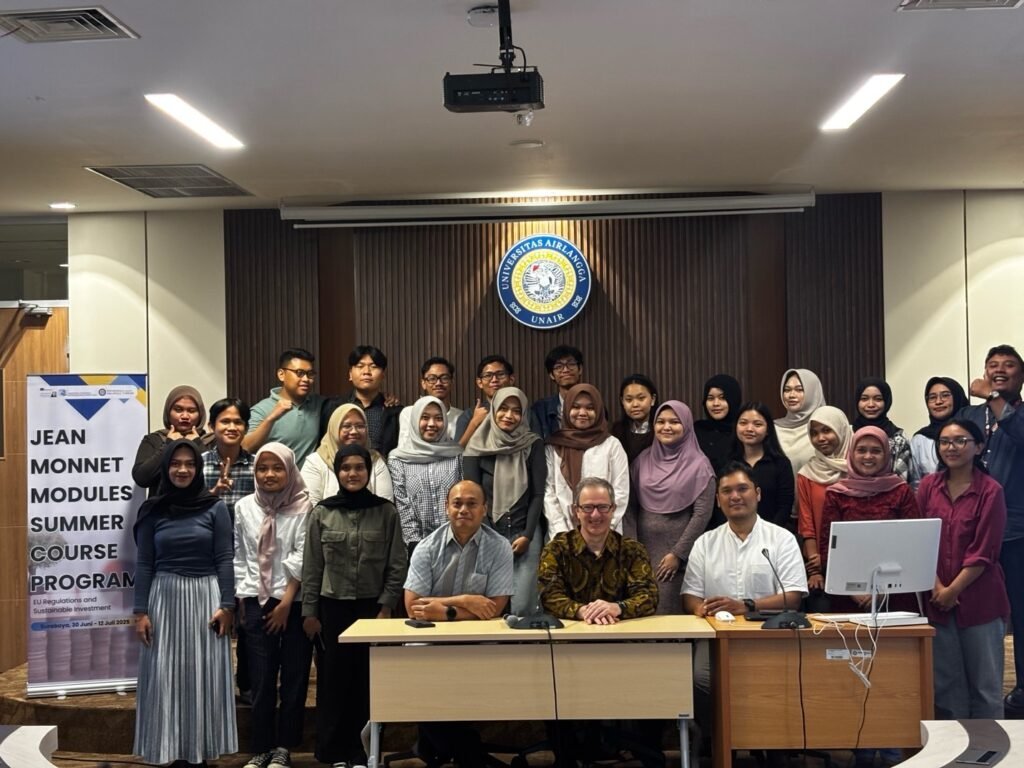
These issues became the focus of another series of academic discussions at the 2026 Jean Monnet Summer Course, hosted by Universitas Airlangga in collaboration with University Telematica Internazionale UniNettuno. The sessions introduced participants to the fundamentals of Indonesian mining law while connecting them with broader principles of European Union law and climate policy.
Through the perspectives presented during the programme, participants were encouraged to understand that legal systems are not static. They evolve alongside economic priorities, environmental challenges, and changing models of governance. The discussions therefore provided a comparative lens through which students could examine how Indonesia and the European Union use legal frameworks to regulate complex economic activities and pursue sustainable development.
Rules Behind Indonesia’s Mining Sector
Legal expert Mr. Franky Butar-butar opened the discussion on the foundations of Indonesian mining law, tracing the historical development of the country’s regulatory framework. His lecture examined how mining governance has evolved alongside changing approaches to natural resource management, particularly concerning the distribution of authority between the central government and regional administrations.
One of the key issues highlighted was the tension between centralised licensing and regional authority. The allocation of regulatory powers is particularly significant in the mining sector because decisions concerning permits, resource exploitation, and environmental management can have substantial economic and social consequences. The discussion demonstrated how Indonesia’s mining framework must continuously navigate the balance between national interests and regional governance.
Butarbutar also emphasised the high-risk nature of mining activities and the legal responsibilities attached to obtaining a mining permit. Mining companies are not only expected to comply with licensing requirements but must also fulfil their environmental obligations, including land reclamation after mining activities. These obligations reinforce the principle that access to natural resources comes with corresponding responsibilities to protect and restore the environment.

Understanding the Legal Architecture of the European Union
The second session shifted the focus to European Union law, introducing participants to the hierarchy of EU legislation and the relationship between its primary and secondary legal instruments. The discussion distinguished between different forms of EU law, including regulations that apply directly and directives that require implementation by member states.
The lecture also explored the principle of the primacy of EU law, under which EU legal rules take precedence over conflicting provisions of national law within areas governed by the Union’s legal framework. This principle demonstrates the distinctive nature of European integration, where member states operate within a shared legal system while retaining significant areas of national authority.
Particular attention was given to the European Green Deal, which positions climate neutrality as part of a broader economic and policy strategy. Rather than treating environmental protection as a separate policy area, the Green Deal integrates climate objectives into economic transformation, regulation, investment, and industrial development. The discussion provided participants with an example of how legal frameworks can be used to support a comprehensive transition toward a more sustainable economy.
Turning Complex Law into Public Knowledge
The academic discussions were complemented by a practical workshop, in which participants were challenged to translate complex international legal concepts into accessible digital content. Students worked on developing a digital newsletter designed to communicate key ideas from the summer course to a broader audience.
The workshop provided an opportunity for participants to move beyond simply understanding legal concepts and instead consider how those concepts can be effectively communicated. Translating topics such as mining regulation, EU legal hierarchy, and climate policy into accessible content requires students to identify the most important principles while maintaining legal accuracy.
This practical component reinforced the broader objective of the Jean Monnet Summer Course 2026: combining academic knowledge with practical skills and encouraging students to engage with international legal issues beyond the classroom. By connecting Indonesian mining law, European Union regulations, and sustainable development with digital communication, the programme created a learning experience that was both comparative and interdisciplinary.


Where Natural Resources Meet Global Legal Thinking
The sessions ultimately demonstrated that both Indonesian mining law and European Union law are shaped by a common challenge: how can legal frameworks support economic activity while protecting broader public and environmental interests?
For Indonesia, the answer involves clear licensing mechanisms, appropriate distribution of governmental authority, and strong environmental obligations for mining operators. For the European Union, it involves a complex legal hierarchy and coordinated policies such as the European Green Deal that seek to integrate climate objectives into economic development.
Through these discussions and the accompanying practical workshop, the Jean Monnet Summer Course 2026 encouraged participants to see law not merely as a collection of technical rules, but as a dynamic instrument for managing resources, coordinating governance, communicating ideas, and responding to global challenges. Ultimately, the programme highlights the importance of legal literacy, comparative thinking, and sustainability in shaping the next generation of international legal practice.