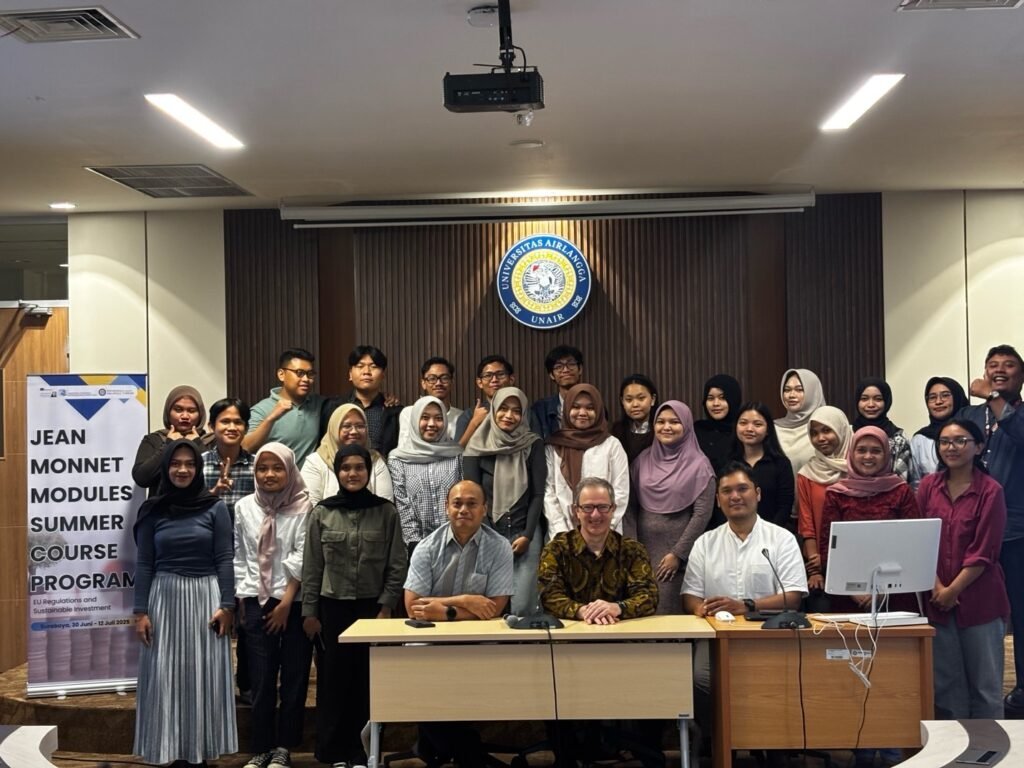
Surabaya, Indonesia — As businesses increasingly operate across borders, their responsibilities extend far beyond economic performance. Corporate activities can affect human rights, shape environmental conditions, and influence communities throughout increasingly complex global supply chains. These challenges formed the focus of another series of academic discussions at the 2026 Jean Monnet Summer Course, hosted by Universitas Airlangga in collaboration with University Telematica Internazionale UniNettuno.
The sessions brought together perspectives on business and human rights, environmental law, European Union regulations, and ecosystem protection, highlighting how legal frameworks can guide companies toward more responsible and sustainable practices. From human rights due diligence to corporate liability for ecological damage and mangrove conservation, the discussions demonstrated that sustainability requires action across multiple layers of law, business, and international cooperation.
Corporate Responsibility and Human Rights
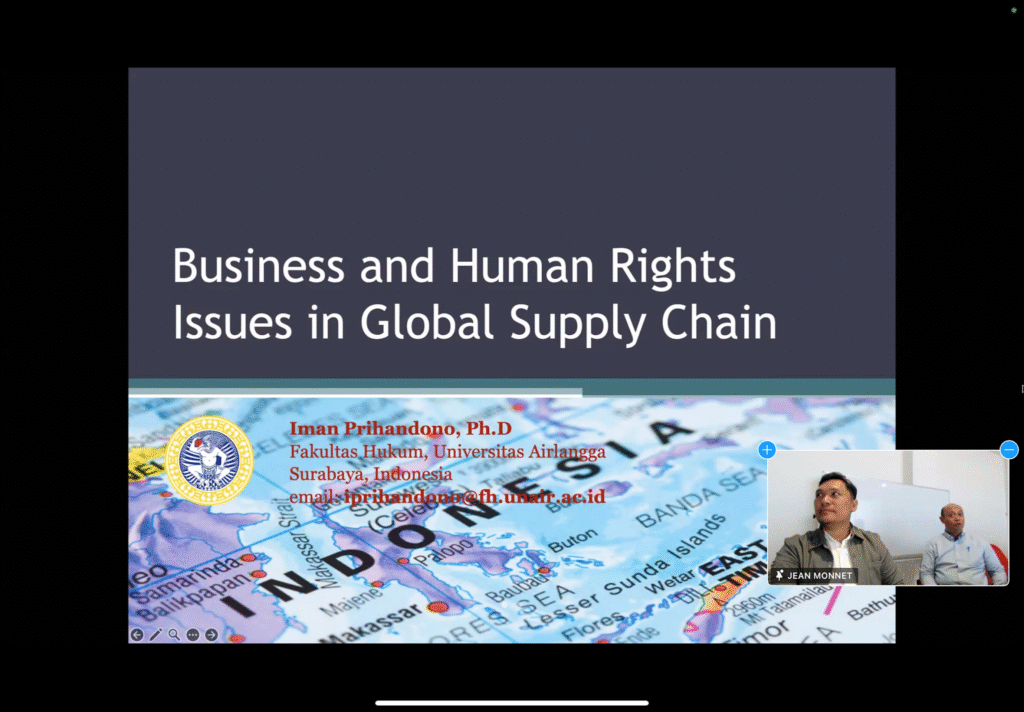
The first session explored the increasingly important relationship between global business operations and human rights protection. The discussion examined how corporate activities can create different forms of human rights impacts, ranging from situations where companies directly cause harm to circumstances in which they contribute to adverse impacts through business partners or become indirectly linked to them through financial and other business relationships.
Particular attention was given to the UN Guiding Principles on Business and Human Rights, which provide an important framework for translating corporate responsibility into concrete action. Rather than treating human rights as a general policy commitment, the framework encourages companies to conduct human rights due diligence, identify potential risks, take preventive and mitigating measures, and communicate their responses transparently.
The discussion ultimately emphasized that corporate responsibility does not stop at the boundaries of a company’s own operations. In an interconnected global economy, companies must also consider the human rights implications of their partnerships, investments, suppliers, and broader business relationships. This perspective positions due diligence as an essential tool for building more responsible and accountable global supply chains.
The Evolution of European Environmental Law
The second session shifted the focus toward the development of Italian and European Union environmental law, illustrating how legal systems have evolved alongside changing understandings of environmental protection. The discussion traced the transformation from earlier approaches centred largely on the protection of cultural and historical heritage toward more comprehensive legal mechanisms addressing environmental harm.
One of the key developments highlighted was the emergence of criminal liability for ecological damage. This evolution reflects a broader recognition that serious environmental harm can have consequences significant enough to warrant stronger forms of legal accountability. Environmental protection, therefore, is no longer viewed solely as an administrative or regulatory concern, but increasingly as an area involving substantive legal responsibility.
The discussion also highlighted the growing “horizontal effect” of European environmental standards. EU regulations and sustainability requirements can influence actors beyond European territory, including international companies and trading partners such as Indonesia. As a result, businesses participating in global markets may increasingly need to understand and comply with standards originating from foreign regulatory systems.
From Legal Compliance to Mangrove Conservation
The final discussion brought the broader legal principles into a practical environmental context through mangrove conservation initiatives. Mangrove ecosystems play a critical role in protecting coastal areas, supporting biodiversity, storing carbon, and sustaining communities that depend on coastal resources. Their protection therefore represents an important dimension of broader sustainability efforts.
The session highlighted the importance of combining scientific collaboration with legal compliance. Protecting vulnerable ecosystems cannot rely solely on environmental regulations or conservation policies; effective implementation also requires scientific knowledge, cooperation among stakeholders, and an understanding of how environmental protection interacts with economic activities.
This perspective becomes particularly relevant within global supply chains, where business operations may have environmental consequences far from a company’s headquarters. Mangrove conservation therefore illustrates how sustainability can move from a legal principle into practical action, connecting corporate responsibility, environmental regulation, scientific expertise, and international cooperation.

Building Responsible and Sustainable Global Business
Taken together, the sessions demonstrated that sustainable business requires more than meeting minimum legal requirements. Companies operating in global markets must increasingly understand how their activities affect people, ecosystems, and communities, while navigating regulatory expectations that may extend across national borders.
The discussions on human rights due diligence and European environmental regulation also revealed the growing convergence between business responsibility and legal accountability. As international standards continue to influence global trade, companies must be prepared to identify risks, prevent harm, demonstrate compliance, and respond transparently to the social and environmental consequences of their activities.
Through these interconnected perspectives, the Jean Monnet Summer Course 2026 encourages participants to view sustainability as a shared legal and global responsibility. From protecting human rights to strengthening environmental accountability and conserving mangrove ecosystems, the sessions highlight one fundamental lesson: responsible business in a global economy requires law, science, and international cooperation to work together.