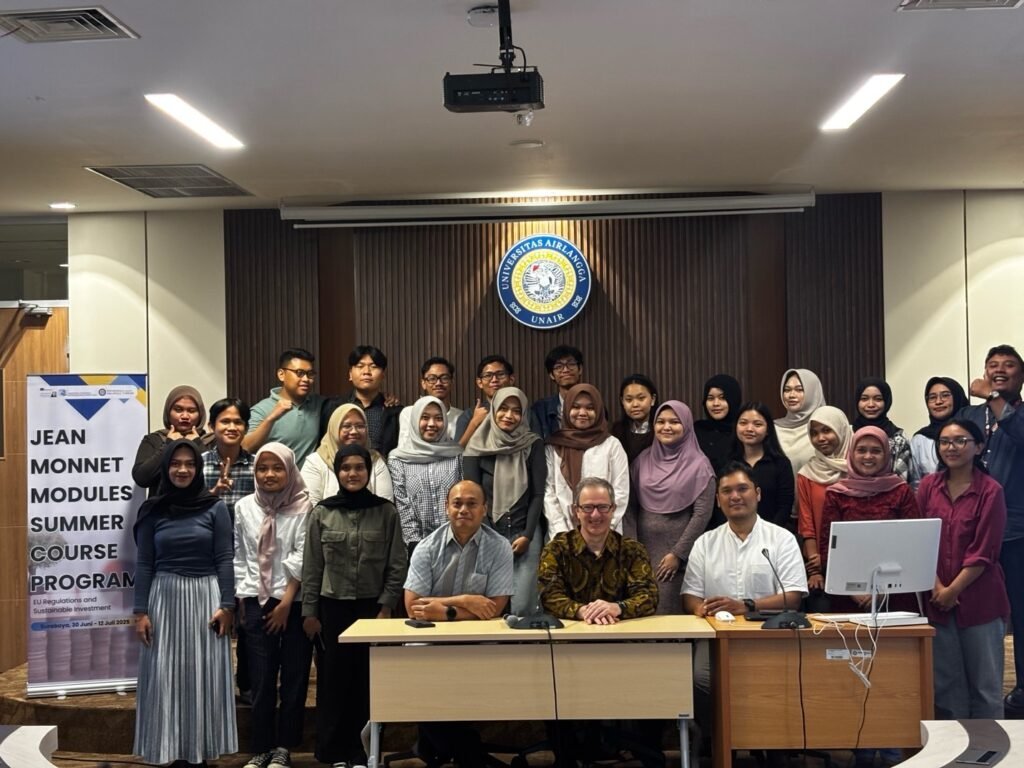
Surabaya, Indonesia — Foreign investment, environmental responsibility, and climate justice may appear to belong to different areas of law. Yet, in an increasingly interconnected global economy, the three are closely linked. Questions surrounding who controls natural resources, how companies communicate their sustainability commitments, and who should be held accountable for environmental destruction are becoming increasingly important in shaping the future of sustainable development.
These issues took centre stage in another series of academic discussions at the 2026 Jean Monnet Summer Course, hosted by Universitas Airlangga in collaboration with University Telematica Internazionale UniNettuno. The sessions brought together perspectives on Indonesian mining law, foreign investment, greenwashing, and international criminal law, encouraging participants to critically examine how legal frameworks can balance economic interests with environmental and social responsibilities.
Through three interconnected perspectives, the discussions revealed that sustainability is not simply about attracting responsible investment or adopting ambitious environmental policies. It also requires clear rules on ownership, transparency in corporate claims, and effective mechanisms for holding those responsible for serious environmental harm accountable.
Foreign Investment and the Challenge of Mining Divestment
The first speaker examined the complex legal framework governing foreign investment and share divestment in Indonesia’s mining sector. Particular attention was given to the obligations imposed on foreign investors to divest shares and the legal distinction between direct and indirect investment. These mechanisms reflect Indonesia’s effort to ensure that foreign participation in strategic natural resources remains aligned with national interests.
However, implementing divestment obligations can raise significant legal and economic challenges. One of the most prominent issues concerns the valuation of shares, particularly in major mining transactions such as those involving Freeport. Differences in how shares are valued can create disputes between investors and the government, raising broader questions about fairness, regulatory certainty, and the protection of investment interests.
The discussion also highlighted concerns over the possibility of indirect nationalisation. While divestment policies may be designed to increase domestic participation in strategic industries, their implementation must carefully balance national interests with the legitimate expectations of foreign investors. The session therefore demonstrated how mining investment law operates at the intersection of economic sovereignty, resource governance, and international investment protection.

When Sustainability Claims Become Greenwashing
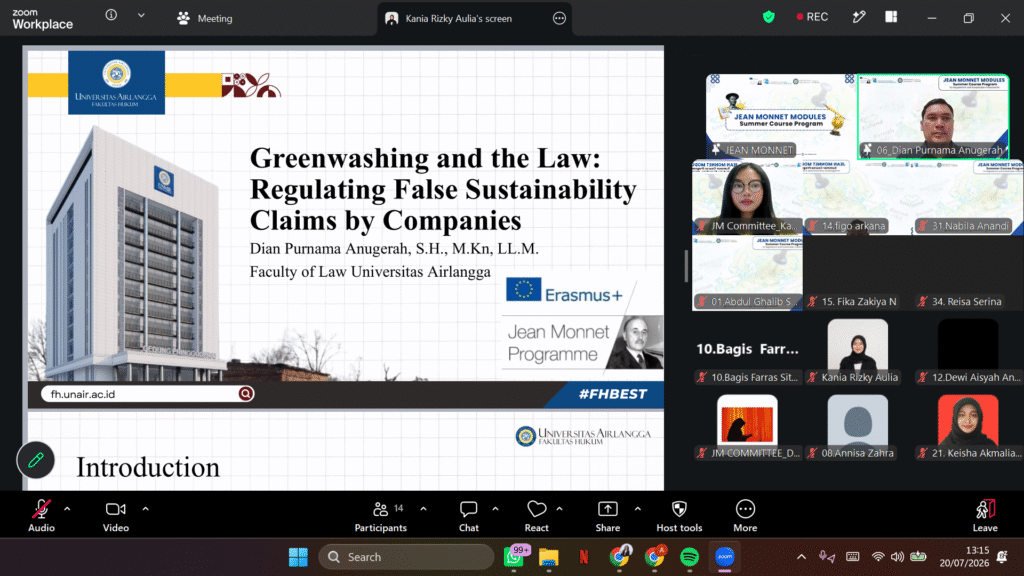
The second speaker shifted the discussion from ownership and investment to the growing phenomenon of greenwashing. As sustainability becomes an increasingly influential factor in consumer and investment decisions, companies are under greater pressure to demonstrate their environmental credentials. However, sustainability claims can become problematic when environmental messages are exaggerated, misleading, or disconnected from a company’s actual practices.
The discussion raised an important legal question: should greenwashing be treated as an unlawful act subject to legal consequences, or should it primarily be regarded as an ethical failure? The answer has significant implications for corporate accountability. If misleading sustainability claims cause consumers or investors to make decisions based on inaccurate information, the issue may extend beyond corporate ethics and enter the realm of legal responsibility.
This perspective highlights the growing importance of transparency and accountability in sustainable business. As companies increasingly position themselves as environmentally responsible actors, legal frameworks may need to evolve to ensure that sustainability claims are supported by genuine action and verifiable information. In this context, combating greenwashing becomes not only a matter of protecting consumers and investors, but also of preserving the credibility of the broader sustainability agenda.
Can International Criminal Law Address Climate Harm?
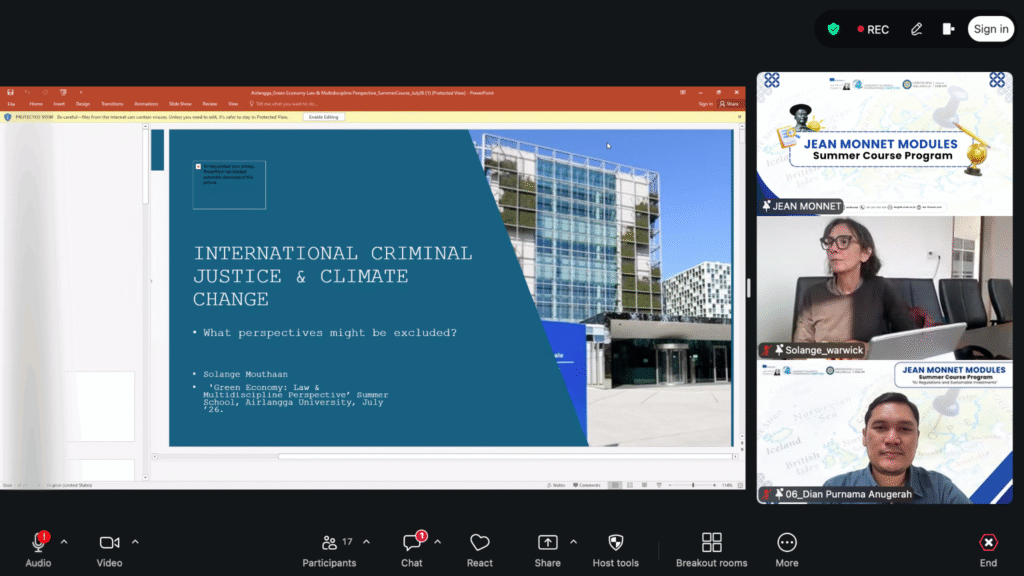
The third speaker brought the discussion to the international level by exploring the potential role of international criminal justice in addressing climate change and severe environmental destruction. At the centre of the discussion was the proposed criminalisation of ecocide, a concept that seeks to recognise exceptionally serious and widespread environmental destruction as an international crime.
The idea raises fundamental questions about accountability. Environmental harm can be extensive, long-lasting, and transnational, while responsibility may involve multiple individuals, corporations, and institutions. Establishing individual criminal liability for ecological destruction therefore presents significant challenges, particularly when environmental damage results from complex economic activities rather than a single identifiable act.
The discussion further emphasised that environmental destruction cannot always be separated from its historical and colonial roots, while its consequences are often distributed unequally across societies. Vulnerable communities, including women, may experience disproportionate impacts from environmental degradation and climate change. Addressing these realities requires international legal frameworks that are capable of recognising not only the scale of ecological harm, but also its social, historical, and structural dimensions.
Rethinking Accountability in a Global Economy
Taken together, the sessions demonstrated how questions of investment, corporate responsibility, and climate justice are increasingly interconnected. Mining divestment policies determine how countries manage foreign participation in strategic resources, while greenwashing raises questions about the integrity of corporate sustainability commitments. At the international level, the debate surrounding ecocide challenges existing notions of criminal accountability for large-scale environmental destruction.
The discussions also highlighted a recurring legal dilemma: how can states protect their environmental and economic interests without undermining legal certainty, while ensuring that corporations and other actors remain accountable for the consequences of their activities? There are no simple answers, particularly when environmental harm occurs across jurisdictions and involves complex networks of investors, corporations, and governments.
Through its comparative and interdisciplinary approach, the Jean Monnet Summer Course 2026 provides participants with an opportunity to examine these challenges from multiple legal perspectives. From Indonesian mining regulations to corporate transparency and the emerging debate on ecocide, the sessions ultimately underscore a broader principle: sustainable development requires not only investment and innovation, but also rules that ensure power comes with responsibility.