Surabaya, Indonesia — As Indonesia accelerates its transition toward a greener economy, carbon markets are emerging as an important intersection between environmental policy and financial regulation. But what exactly is a carbon unit? Can it be treated like a financial security? And how should the law regulate an instrument that carries both economic value and environmental significance?
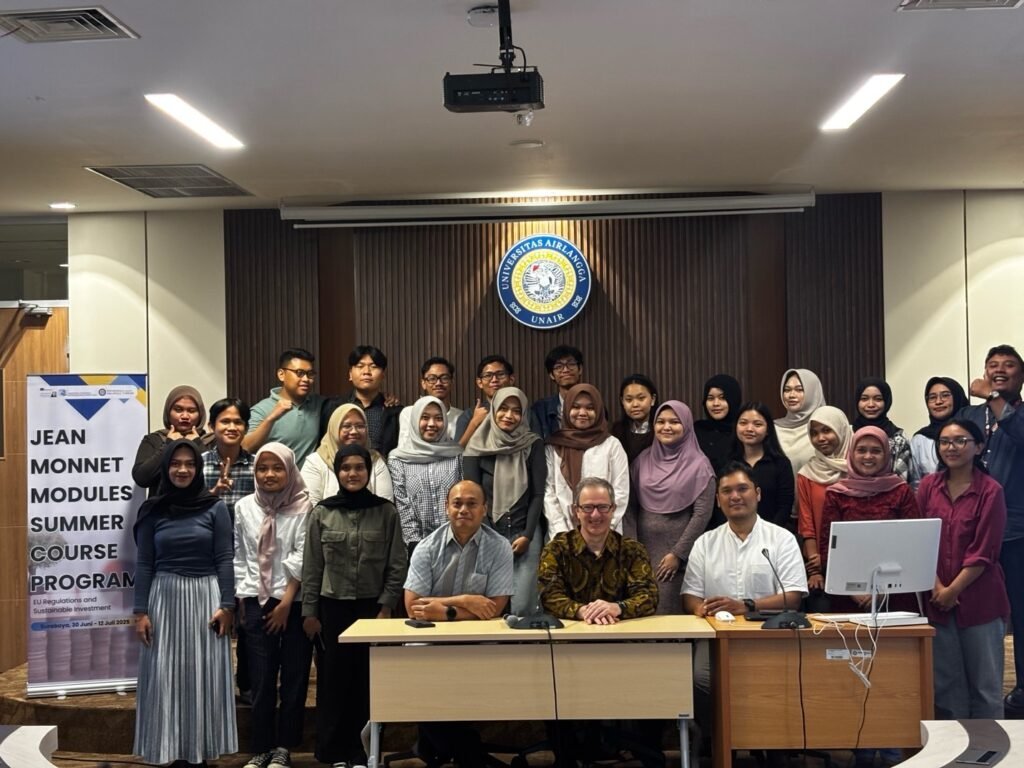
These questions shaped another series of academic discussions at the 2026 Jean Monnet Summer Course, hosted by Universitas Airlangga in collaboration with University Telematica Internazionale UniNettuno. The sessions explored the legal and economic dimensions of carbon units, securities, and green economy regulation, highlighting the need for legal frameworks that can keep pace with Indonesia’s sustainability ambitions.
The discussions also placed Indonesia’s carbon market within a broader international context. As global businesses face increasingly demanding sustainability requirements, including European regulations on supply chain responsibility, Indonesia must develop regulatory approaches that can encourage green investment while ensuring that environmental protection remains at the centre of economic development.
Understanding the Value Behind a Carbon Unit
The first discussion examined the fundamental distinction between securities and carbon units. Securities are generally understood as tradable financial instruments that represent ownership, debt, or another financial interest. Carbon units, by contrast, function primarily as environmental instruments representing a quantified amount of greenhouse gas reduction or emission-related value.
Under the Indonesian regulatory framework, carbon units are not simply created and placed on the market. Their generation depends on a rigorous measurement, reporting, and verification (MRV) process designed to ensure that claimed emission reductions are measurable, credible, and verifiable. Once validated, carbon units can be traded through specialised carbon exchanges as part of efforts to meet emission reduction targets.
This framework demonstrates the unique position of carbon units within the modern economy. They carry economic value and can be traded, yet their underlying purpose is closely tied to environmental outcomes. The discussion therefore highlighted the importance of ensuring that the legal framework surrounding carbon markets preserves the environmental integrity of carbon units while providing sufficient certainty for market participants.
Should Carbon Units Be Treated as Securities?
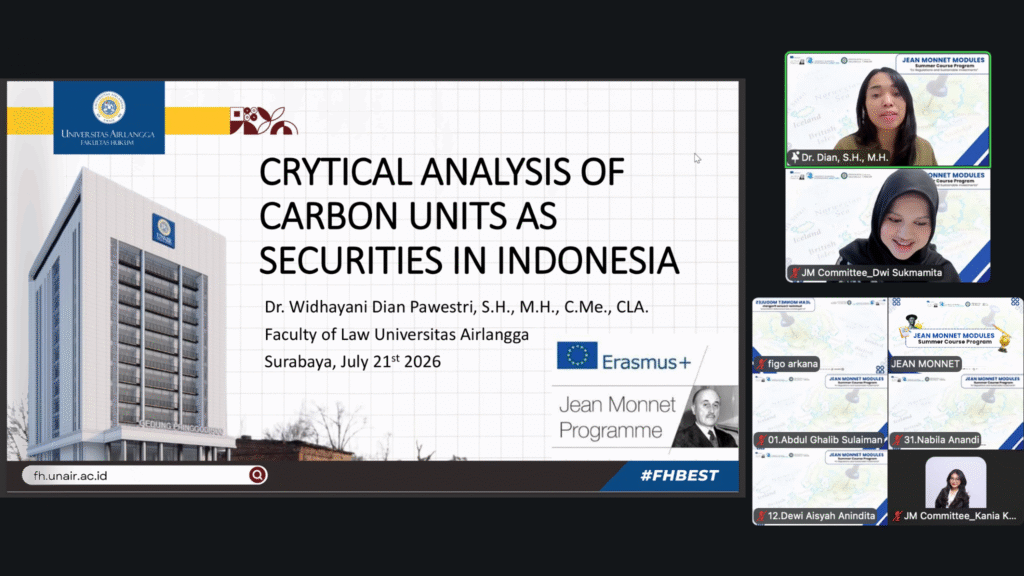
The second discussion addressed one of the most important legal questions surrounding carbon markets: should carbon units be classified as securities? At first glance, their tradable nature and economic value may suggest similarities with financial instruments. However, their underlying characteristics raise important legal distinctions.
A key issue is that carbon units possess a unique function as consumable environmental assets. Unlike conventional securities, which may represent ownership or a claim against an issuer, a carbon unit is connected to the achievement and accounting of an environmental objective. Its value is therefore influenced not only by market demand, but also by regulatory frameworks, emission targets, and the credibility of the underlying environmental claim.
The debate highlights why applying conventional financial regulations to carbon markets may not always provide an adequate solution. Instead, the legal system may require tailored regulatory standards that recognise the distinctive characteristics of carbon units. Such an approach could provide greater legal certainty for market participants while ensuring that carbon trading genuinely contributes to emissions reduction rather than becoming merely another financial activity.
Green Economy Beyond Indonesia’s Borders
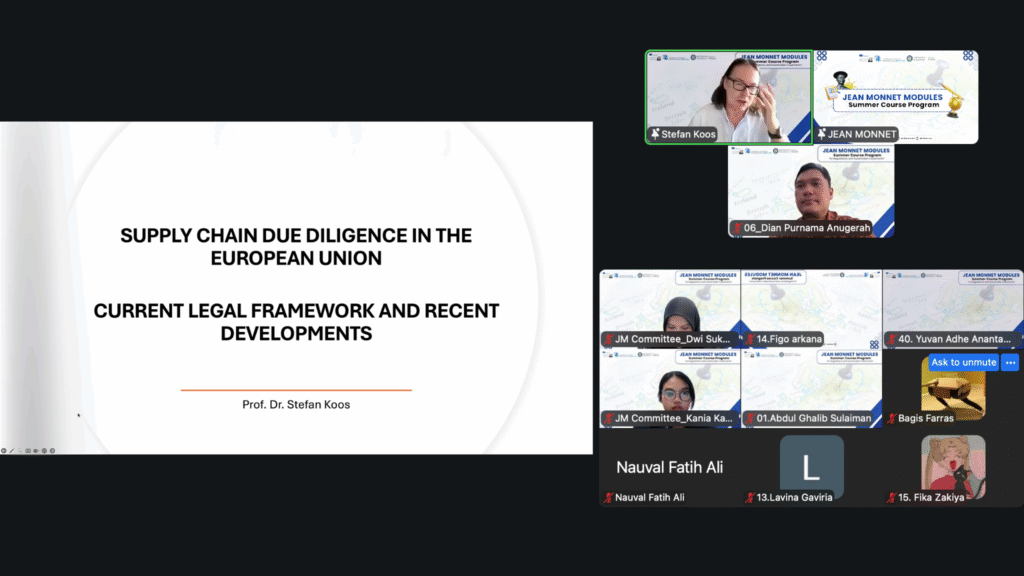
The third discussion placed Indonesia’s green economy within the context of international sustainability regulations, including the European Union’s Supply Chain Due Diligence framework. As businesses increasingly operate across borders, environmental and social responsibilities are no longer determined solely by the regulations of the country where production takes place.
European sustainability requirements can influence companies and suppliers outside the EU, including businesses participating in Indonesian supply chains. This creates new expectations for transparency, environmental responsibility, and due diligence throughout the production process. Indonesian companies seeking access to international markets may therefore need to understand and adapt to regulatory standards originating beyond their domestic legal system.
The discussion emphasised that the green economy must ultimately balance economic growth with environmental protection. Regulatory frameworks should encourage investment and innovation while safeguarding both marine and terrestrial ecosystems. Carbon markets and supply chain regulations can contribute to this transition, but their effectiveness depends on clear rules, credible verification mechanisms, and meaningful environmental outcomes.

Designing Rules for a Greener Market
Taken together, the discussions demonstrate that carbon markets represent far more than a new financial opportunity. They sit at the intersection of environmental regulation, financial law, international trade, and sustainable development, creating new legal questions that traditional regulatory frameworks may not fully address.
The debate over the legal status of carbon units illustrates the need for regulation that understands their distinctive character. Meanwhile, the growing influence of international sustainability requirements demonstrates that Indonesia’s green economy cannot be developed in isolation from global regulatory developments.
Through the Jean Monnet Summer Course 2026, participants were encouraged to critically examine how law can respond to emerging environmental markets without losing sight of their underlying purpose. Ultimately, the challenge is not simply to create a market for carbon, but to build a regulatory system in which economic value and environmental value move in the same direction toward a more sustainable future.