Surabaya, Indonesia — Can bankruptcy become more than a mechanism for resolving financial failure? Can technological innovation accelerate the green transition without creating new legal challenges? And how can economic development move forward without compromising environmental protection?
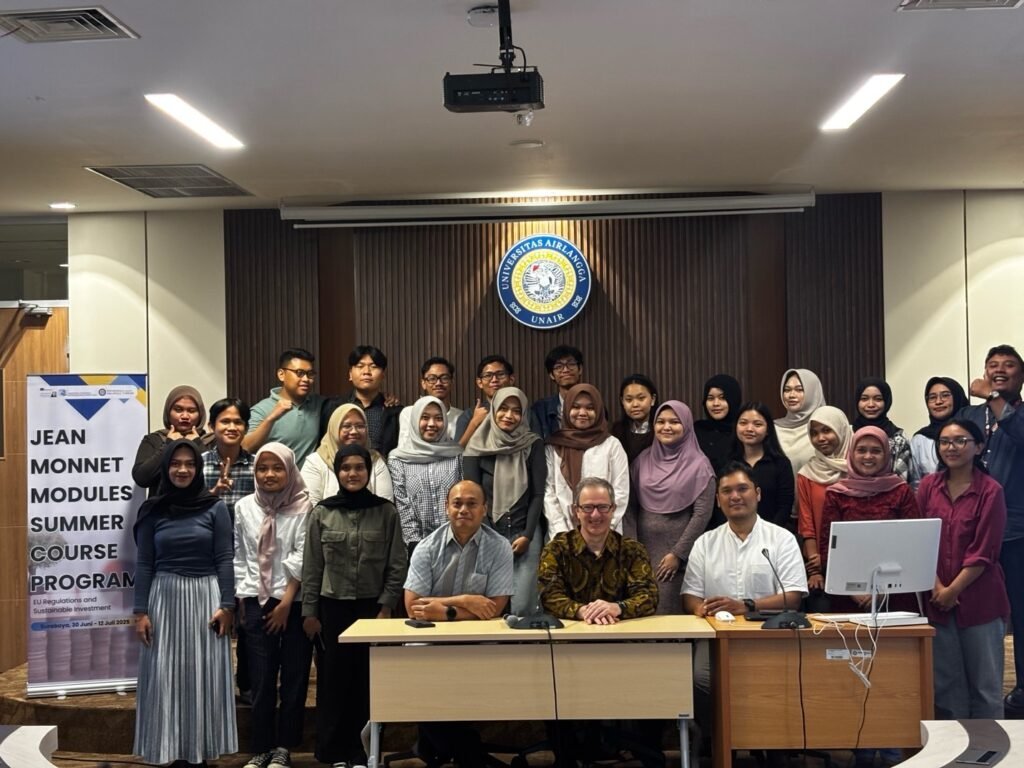
These questions shaped another series of discussions at the 2026 Jean Monnet Summer Course, hosted by Universitas Airlangga in collaboration with University Telematica Internazionale UniNettuno. Bringing together perspectives on environmental law, bankruptcy, the green economy, renewable energy, and intellectual property, the sessions explored how law can respond to increasingly complex challenges at the intersection of economic development and sustainability.
Rather than viewing these areas as separate legal fields, the discussions demonstrated how closely they are connected. Environmental damage can create financial and legal claims, the transition to a green economy requires new regulatory approaches, while intellectual property can determine whether sustainable technologies become widely accessible or remain commercially restricted.
When Bankruptcy Becomes an Environmental Question
The first session examined the relationship between environmental damage and bankruptcy proceedings, particularly in the context of Indonesia’s mining sector. The discussion highlighted the ecological consequences associated with nickel and coal mining, raising an important legal question: what happens to environmental obligations when a company can no longer meet its financial responsibilities?
The speaker proposed that bankruptcy procedures could be utilised as a mechanism for recovering environmental claims. Rather than treating environmental obligations as ordinary debts competing equally with other creditors, environmental claims and administrative fines could receive greater priority in the distribution of a bankrupt company’s assets. Such an approach could strengthen accountability by ensuring that corporate insolvency does not become a pathway for avoiding responsibility for environmental harm.
This perspective expands the conventional understanding of bankruptcy. Instead of focusing exclusively on financial recovery, bankruptcy law could also play a role in enforcing the polluter-pays principle and protecting public environmental interests. In the context of resource-intensive industries, the proposal highlights the need for legal systems capable of ensuring that economic failure does not leave society to bear the costs of ecological damage.

Green Growth in a Changing Climate
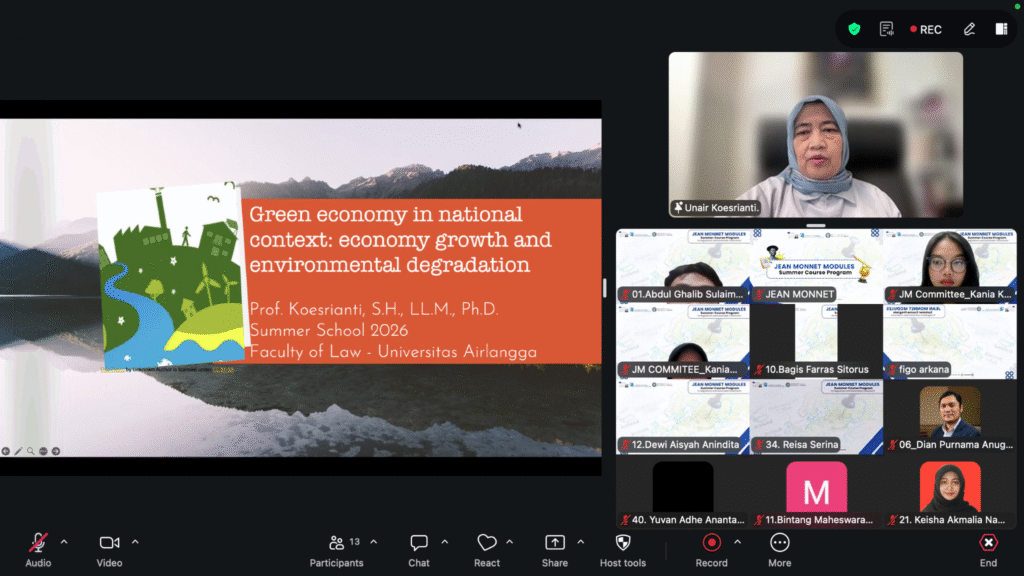
The second speaker shifted the discussion toward the broader concept of the green economy, examining the difficult balance between industrial development and climate mitigation. Economic growth continues to depend heavily on industrial activity and energy consumption, while the urgency of addressing climate change requires countries to reduce emissions and transition toward more sustainable economic models.
The discussion emphasised that this transition cannot be achieved through isolated national policies. International cooperation is essential because climate change and environmental degradation transcend national borders, while energy markets and industrial supply chains are increasingly interconnected. Countries therefore need to coordinate policies, share knowledge and technology, and develop regulatory frameworks capable of supporting a more sustainable global economy.
Particular attention was given to the importance of renewable energy in supporting the green transition. Moving away from carbon-intensive energy sources presents significant opportunities, but it also creates legal, economic, and political challenges. The discussion consequently encouraged participants to understand the green economy not simply as an environmental agenda, but as a transformation that requires coordinated action across law, industry, technology, and international relations.
Can Intellectual Property Accelerate Sustainability?
The third discussion explored a different dimension of sustainable development: the role of intellectual property rights in encouraging sustainable innovation. Technological innovation is critical to addressing environmental challenges, from renewable energy systems to technologies designed to improve resource efficiency. Yet the legal protection granted to innovators can also affect how quickly these technologies become accessible to society.
The speaker examined the tension between intellectual property protection and the broader public interest, particularly through the concept of compulsory licensing. While intellectual property rights can provide incentives for companies and researchers to invest in innovation, exclusive rights may also create barriers when important technologies are needed to respond to urgent environmental or societal challenges. Compulsory licensing therefore raises important questions about when public interests may justify greater access to protected technologies.
These challenges become even more complex with the rapid development of artificial intelligence (AI). As AI increasingly influences research, innovation, and industrial processes, existing intellectual property frameworks face new questions concerning ownership, access, and the regulation of emerging technologies. The discussion highlighted the importance of ensuring that intellectual property law continues to support innovation while remaining responsive to the wider objectives of sustainable development.

Balancing Growth with Responsibility
Taken together, the three discussions reveal that sustainability cannot be achieved through a single legal instrument. Bankruptcy law, environmental regulation, energy policy, and intellectual property rights can all influence how societies respond to environmental and economic challenges.
The discussion on environmental claims demonstrates the importance of ensuring that companies remain accountable for ecological harm even when facing financial collapse. Meanwhile, the green economy perspective highlights the need to reconcile industrial growth with climate objectives through international cooperation and renewable energy. The intellectual property discussion adds another layer by showing how access to innovation can determine the effectiveness of sustainability efforts.
Through these interconnected perspectives, the Jean Monnet Summer Course 2026 encourages participants to look beyond conventional legal boundaries and consider how different areas of law can work together to support sustainable development. Ultimately, the challenge is not simply to choose between economic growth and environmental protection, but to develop legal frameworks capable of making economic progress more responsible, innovative, and sustainable.