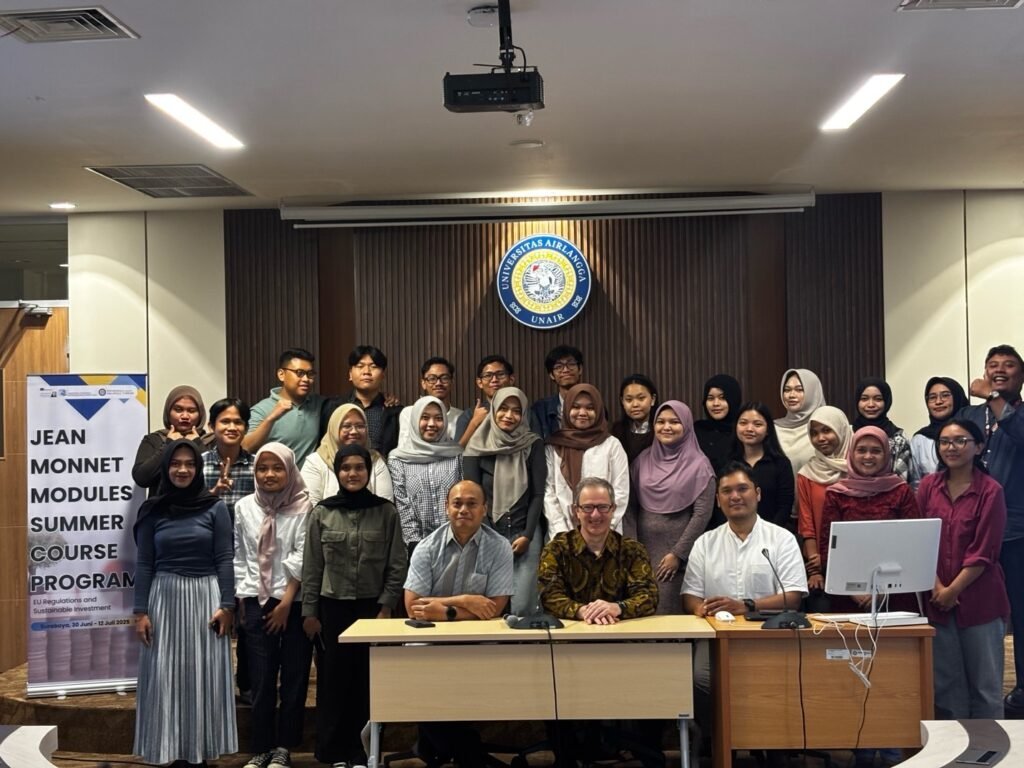
Surabaya, Indonesia — Global trade keeps the world moving, but it also comes with an environmental and legal cost. From ships crossing international waters to multinational companies operating across jurisdictions, the global economy faces an increasingly important question: how can economic activity remain competitive while meeting the demands of a more sustainable future?
This question became the focus of another series of academic discussions at the 2026 Jean Monnet Summer Course, hosted by Universitas Airlangga in collaboration with University Telematica Internazionale UniNettuno. The sessions brought together perspectives on shipping decarbonisation, international taxation, and competition law, demonstrating how seemingly distinct areas of law are increasingly connected to the global sustainability agenda.
Rather than examining sustainability from a single legal perspective, the discussions encouraged participants to understand how regulatory frameworks are evolving across different sectors. From reducing emissions in maritime transport to addressing corporate tax practices and incorporating sustainability into competition policy, the sessions highlighted the changing role of law in shaping a greener and more ethical global economy.
Decarbonising the Ships Behind Global Trade
The first session focused on the urgent challenge of decarbonising the maritime industry. Shipping plays a fundamental role in global trade, connecting markets and facilitating the movement of goods across continents. At the same time, the scale of maritime activity contributes significantly to global greenhouse gas emissions, making the sector an important target in international climate efforts.
The discussion examined the regulatory challenges surrounding shipping decarbonisation, particularly within the framework of the International Maritime Organization (IMO). Because maritime transport operates across national borders, reducing emissions cannot rely solely on individual national regulations. Effective decarbonisation requires international standards capable of coordinating countries, shipping companies, and other actors across a highly interconnected industry.
The session ultimately highlighted the complexity of balancing environmental ambition with the practical realities of global trade. Decarbonising shipping requires not only technological innovation and cleaner fuels, but also coherent international regulation and effective implementation. The maritime sector therefore provides a clear example of how sustainability challenges increasingly demand cross-border legal and policy solutions.

Navigating the Fine Line Between Tax Avoidance and Evasion
The second session shifted the discussion from environmental regulation to international tax law, exploring the legal distinction between tax avoidance and tax evasion. As multinational corporations operate across multiple jurisdictions, differences between national tax systems can create complex questions regarding where companies should be taxed and how their financial structures should be regulated.
Through corporate case studies, including Starbucks, students were encouraged to examine how multinational companies navigate international tax rules. The discussion demonstrated that determining whether a particular tax strategy constitutes legitimate tax planning or unlawful evasion can involve intricate questions of corporate structure, jurisdiction, and legal interpretation.
Beyond the technical distinction, the session also highlighted the broader importance of fairness and accountability in the global economy. International tax rules influence how resources are distributed between corporations, governments, and societies. Ensuring that multinational businesses operate transparently and responsibly is therefore an important component of building a global economic system that is not only efficient, but also equitable and sustainable.

When Competition Law Meets Sustainability
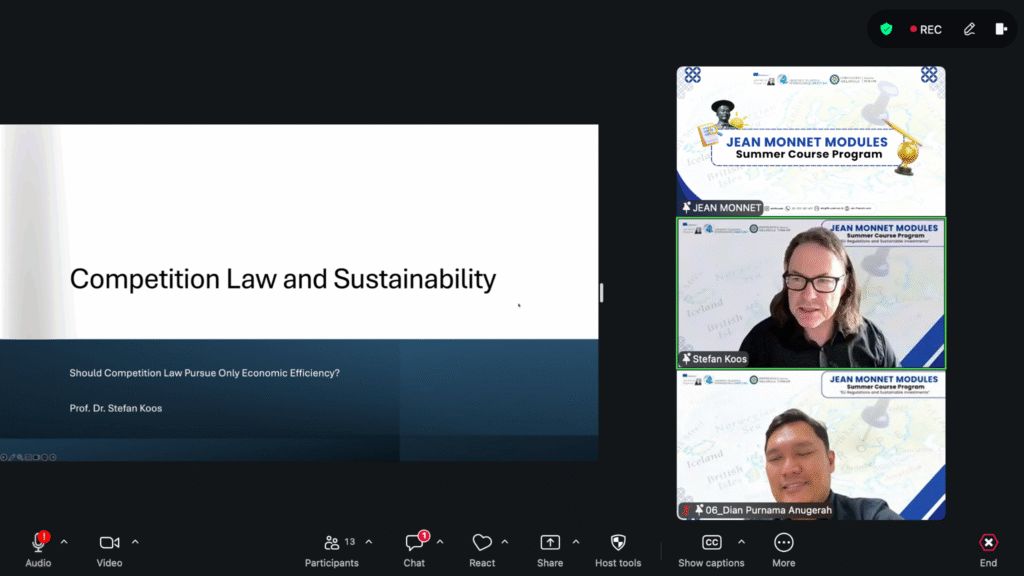
The final session explored the evolving relationship between competition law and sustainability objectives. Traditionally, competition or antitrust frameworks have focused heavily on preventing anti-competitive conduct and protecting consumer welfare. However, growing environmental challenges have prompted regulators and scholars to reconsider whether competition law can also accommodate broader sustainability goals.
The discussion examined how antitrust frameworks are increasingly being challenged to respond to agreements and business practices that may generate environmental benefits while potentially affecting traditional measures of competition. This raises difficult questions about how regulators should balance sustainability objectives with concerns over market power, efficiency, and consumer welfare.
The session therefore highlighted a broader transformation in the role of competition law. Rather than viewing environmental sustainability and economic competition as inherently conflicting objectives, legal frameworks may need to explore ways in which both can be pursued simultaneously. This evolving perspective reflects a wider shift toward using economic regulation as a tool for supporting sustainable development.
Reimagining the Rules of the Global Economy
Taken together, the three sessions demonstrate how sustainability is reshaping multiple areas of law. Shipping regulation is being challenged to reduce emissions without disrupting global trade, international tax law is confronting questions of corporate responsibility and fairness, while competition law is increasingly engaging with environmental objectives alongside traditional economic considerations.
These discussions reveal that building a greener global economy requires more than environmental legislation alone. It demands regulatory coordination across sectors and borders, as well as legal frameworks capable of responding to the increasingly interconnected nature of modern economic activity.
Through its multidisciplinary approach, the Jean Monnet Summer Course 2026 provides participants with an opportunity to explore how law can adapt to these emerging challenges. From the ships that carry global trade to the corporations that operate across borders and the markets in which they compete, the sessions underscore a common principle: the future of the global economy will depend on how effectively legal systems can reconcile growth, fairness, competition, and sustainability.