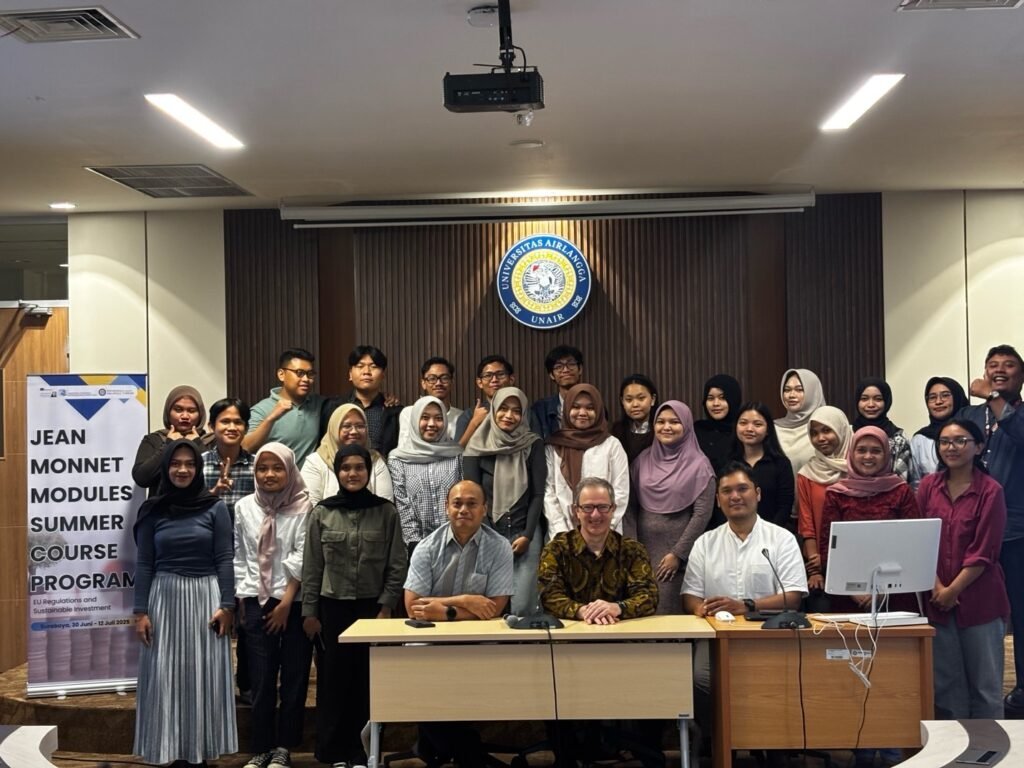
Surabaya, Indonesia — Sustainability is often discussed through the language of renewable energy, emissions reduction, and green investment. Yet, there is another factor that can fundamentally undermine these efforts: war. Armed conflicts can destroy ecosystems, displace communities, disrupt economies, and generate environmental damage that may remain largely invisible in global climate calculations.
These issues became the focus of another series of academic discussions at the 2026 Jean Monnet Summer Course, hosted by Universitas Airlangga in collaboration with University Telematica Internazionale UniNettuno. The sessions examined the less visible costs of sustainable development, connecting the environmental consequences of warfare with the role of financial systems and corporate governance in advancing the green economy.
Together, the discussions challenged participants to reconsider what sustainability truly requires. Achieving environmental goals is not only a matter of reducing emissions or increasing green investment, but also of addressing the structural conditions that enable environmental destruction and ensuring that governments, financial institutions, and corporations take responsibility for climate-related risks.
When War Becomes an Environmental Crisis
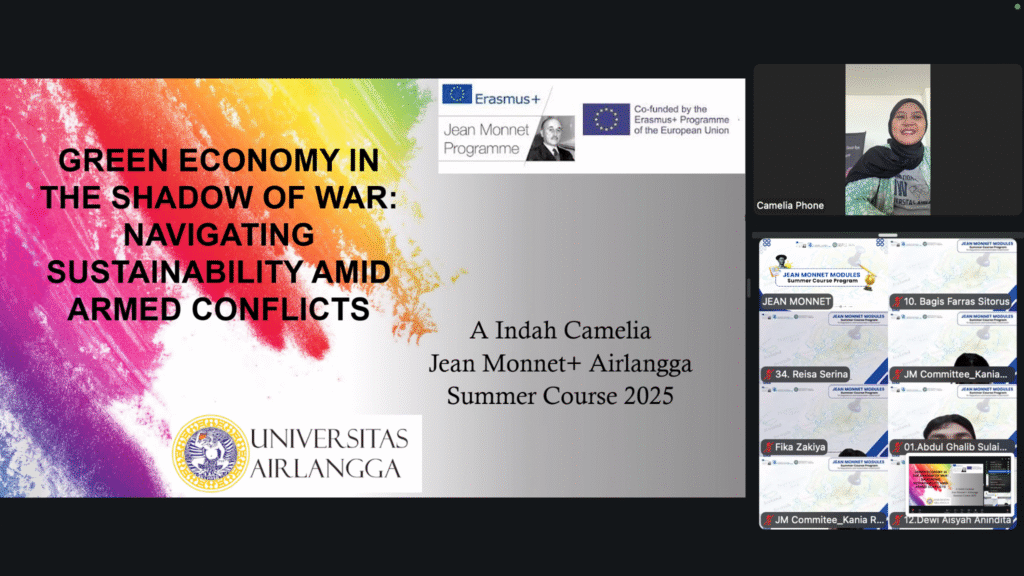
The first discussion examined armed conflict as a major driver of environmental destruction. Beyond the immediate humanitarian consequences of warfare, military activities can damage ecosystems, contaminate land and water, destroy infrastructure, and accelerate the displacement of communities. These impacts demonstrate that environmental consequences of conflict can extend far beyond the battlefield.
A particularly important concern raised in the discussion was the existence of a “blind spot” in international climate accounting. While global climate frameworks increasingly measure emissions from economic activities, the environmental consequences of armed conflict can be difficult to capture within conventional accounting systems. As a result, significant environmental damage may remain underreported or inadequately reflected in global sustainability assessments.
The discussion consequently positioned peace as an essential condition for sustainable development. Environmental protection cannot be pursued effectively when ecosystems are being destroyed by conflict and communities are forced to abandon their homes. The relationship between peace and sustainability therefore extends beyond political stability: maintaining international peace is also fundamental to protecting the environmental foundations upon which sustainable development depends.
Making Finance Work for the Planet
The second discussion turned to the role of financial flows in the transition toward a green economy. Sustainable development requires capital to move toward activities that support environmental preservation, yet financial decisions can also contribute to projects and industries that place additional pressure on ecosystems. Aligning financial flows with ecological objectives therefore becomes a critical component of the global sustainability transition.
Particular attention was given to the importance of transparent disclosure regulations. Investors and other stakeholders need reliable information about how companies identify and manage environmental and climate-related risks. Without adequate disclosure, it becomes more difficult to distinguish genuine sustainability efforts from activities that merely appear environmentally responsible.
The discussion highlighted that transparency is therefore more than a reporting requirement. Effective disclosure can help redirect capital toward sustainable activities, improve accountability, and provide markets with the information necessary to evaluate long-term environmental risks. In this sense, financial regulation can become a powerful instrument for ensuring that economic decisions are increasingly aligned with the planet’s ecological boundaries.

Putting Climate Risk in the Boardroom
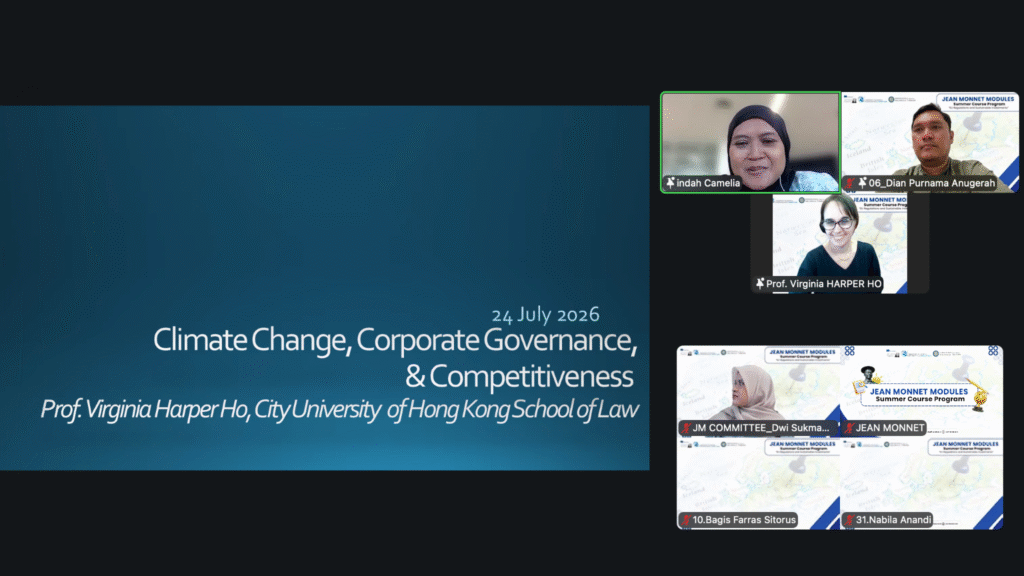
The third discussion focused on corporate governance and the responsibilities of corporate boards in responding to climate change. As environmental risks increasingly affect supply chains, investment decisions, market conditions, and regulatory requirements, climate change can no longer be treated solely as an environmental issue. It has become a strategic business concern with direct implications for corporate performance and long-term competitiveness.
The discussion emphasised that corporate boards have an important role in integrating climate risk management into strategic decision-making. This means considering environmental risks when developing business strategies, allocating capital, assessing investments, and preparing for regulatory and market changes. Climate governance must therefore move beyond sustainability departments and become part of the core decision-making structure of companies.
Such an approach can also strengthen long-term economic competitiveness. Companies that effectively anticipate climate risks may be better positioned to adapt to changing regulations, consumer expectations, technological developments, and market conditions. Corporate governance, therefore, becomes an important bridge between environmental responsibility and economic resilience.
Rethinking What Sustainable Development Really Means
Taken together, the sessions reveal that sustainable development cannot be separated from the broader political and economic systems in which it takes place. War can destroy ecosystems and create environmental impacts that remain underrepresented in climate accounting. Financial systems can either accelerate or obstruct the green transition. Corporate boards can either treat climate risk as a peripheral concern or integrate it into long-term business strategy.
These perspectives also demonstrate that sustainability requires action at multiple levels. International peace is necessary to prevent large-scale environmental destruction, transparent financial disclosure is essential for directing capital toward sustainable activities, and responsible corporate governance is critical for ensuring that businesses operate within planetary boundaries.
The Jean Monnet Summer Course 2026 therefore encourages participants to look beyond conventional approaches to environmental regulation and consider the wider systems that shape sustainability. Ultimately, the pursuit of a green economy is not simply about building a cleaner economy—it requires peaceful international relations, accountable financial systems, and corporations willing to place long-term planetary resilience at the heart of economic decision-making.